


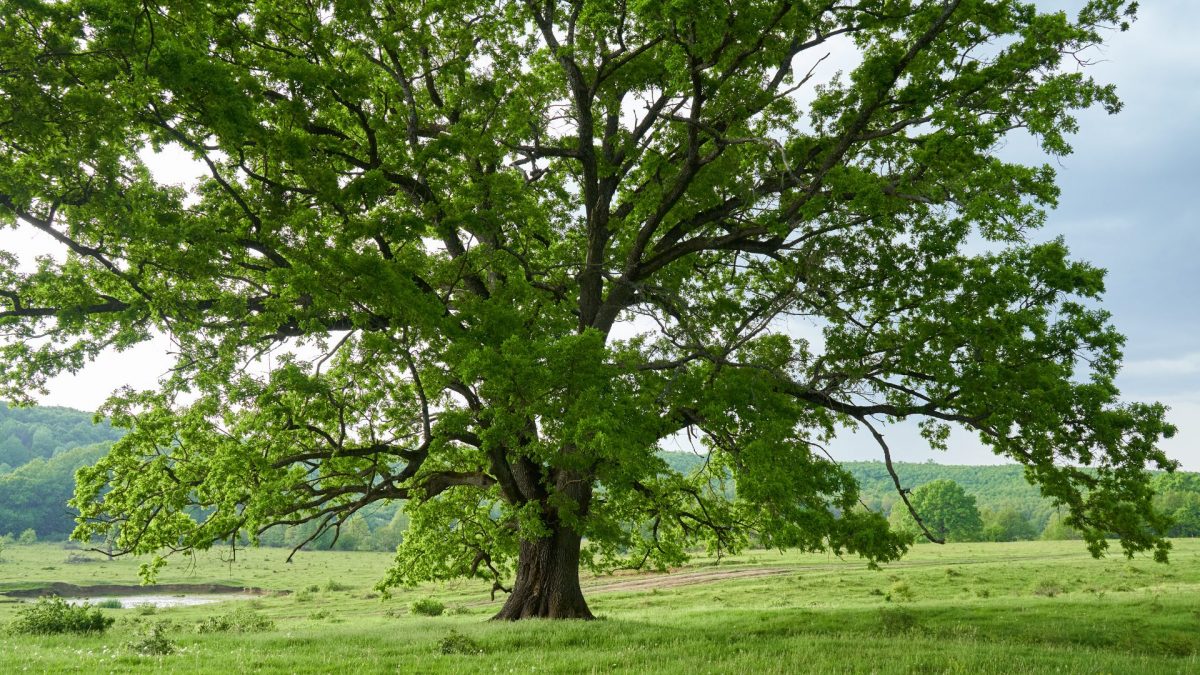
Oak (Quercus) is a powerful and long-lived tree that plays an important role in ecosystems and landscaping.
🌳 Oak (Quercus) – Symbol of Strength and Longevity
🌿 General Description
The oak is an imposing, long-living, and resilient tree from the Fagaceae family, valued both for its high-quality wood and its ecological and symbolic importance. In many cultures, the oak is seen as a symbol of power, durability, and wisdom.
🔬 Botanical Classification
- Kingdom: Plantae
- Class: Magnoliopsida
- Order: Fagales
- Family: Fagaceae
- Genus: Quercus
- Common species:
- Quercus robur (Pedunculate oak)
- Quercus petraea (Sessile oak)
- Quercus pubescens (Downy oak)
🌱 Botanical Characteristics
- Height: 🌳 20–40 meters (some specimens can exceed 50 m)
- Lifespan: ⏳ Over 500 years (exceptionally up to 1,000 years)
- Leaves: 🍃 Deciduous, lobed with wavy edges and visible veins
- Flowers: 🌸 Small, yellow-green, monoecious (male and female flowers on the same tree)
- Fruit: 🌰 Acorn – an important food source for wildlife
🌍 Geographical Distribution
Oaks are native to the Northern Hemisphere, found in:
- Europe – 🌿 Romania, Germany, France, United Kingdom
- Asia – 🌿 Turkey, Caucasus, China
- North America – 🌿 USA, Canada, Mexico
- North Africa – 🌿 Morocco, Algeria (isolated species)
Romania has one of the largest natural oak forest areas in Central and Eastern Europe.
🧪 Chemical Composition
- Tannins – with astringent and antimicrobial effects
- Flavonoids – antioxidants
- Phenolic acids – with anti-inflammatory properties
- Essential oils – found in bark and leaves
🩺 Medicinal Uses
Oak has applications in phytotherapy, especially through its tannin-rich bark:
- 🌿 Infusion or decoction from bark: for diarrhea, intestinal inflammations
- 🌿 Gargle: for pharyngitis and stomatitis
- 🌿 Local baths: for hemorrhoids, eczema, excessive sweating
- 🌿 Oak tincture: tonic or antiseptic
🪵 Practical Uses
- Wood industry:
- 🔨 Luxury furniture
- 🛢️ Barrels for wine and spirits (e.g., whisky)
- 🏗️ Flooring, beams, structural supports
- Agriculture:
- Acorns sometimes used as animal feed
- Shipbuilding: historically preferred wood for ships
- Parks and landscaping: planted for shade, soil stabilization, and monumental appearance
🐿️ Ecological Importance
- 🌱 Habitat: supports impressive biodiversity – over 300 species of insects, birds, and mammals can live in or around a mature oak
- 🐦 Associated fauna: acorns feed wild boars, squirrels, deer, birds
- 🍄 Mycorrhiza: roots form symbiosis with fungi such as truffles and boletes
🧵 Symbolism and Culture
- 🔱 In Greco-Roman mythology, oak was sacred to Zeus/Jupiter
- 🇷🇴 In Romanian folklore, the oak symbolizes strength, uprightness, and masculinity
- 🎖️ Emblems: used as a symbol in heraldry, medals, coats of arms, seals
- 🕊️ Tree of peace and longevity in many cultures
🧾 Cultivation and Care
- Soil: prefers deep, clayey, well-drained soils
- Light: loves sun exposure
- Moisture: resistant to moderate drought
- Pruning: rare, only for shaping young trees
- Propagation: by acorns (planting in autumn or spring)
⚠️ Precautions and Legal Aspects
- 🌳 Oak is protected in many countries (including Romania) as a species with ecological and historical value
- ❗ Acorns are not edible raw for humans – can cause digestive issues due to tannins
📚 Curiosities
- 📏 A mature oak can have a crown diameter over 20 meters
- ⏳ The oldest oak in Romania is “The Old Man of the Carpathians,” estimated to be over 900 years old
- 🧠 Oak wood is extremely dense, making it very heavy (over 700 kg/m³)